Trace
A contextual understanding layer that helps software teams reconstruct the reasoning, relationships, and context behind unfamiliar work.
- Role
- Product Designer
- Domain
- Enterprise SaaS
- Timeline
- 60 days
Overview
Trace is a contextual understanding layer for software teams, designed to help Product Managers and Developers reconstruct the reasoning, relationships, and context behind unfamiliar work. The challenge is not simply finding more information. It is understanding why the work is the way it is. Trace explores whether AI can connect fragmented artifacts and reconstruct the rationale behind unfamiliar work rapidly enough to be useful and honestly enough to be trusted.
Problem & Context
Every software team eventually inherits work it did not create. The artifacts are usually there: tickets, PRDs, commits, documentation, designs, and discussions. But the reasoning behind those artifacts is often not. Existing tools solve important parts of the problem, but retrieval alone does not establish why a decision was made, how related artifacts connect, what constraints mattered, or where evidence is missing or conflicting.
Users & Research
Product Managers
May inherit unfamiliar projects, roadmaps, decisions, and product context. They need to understand current state, rationale, trade-offs, dependencies, supporting evidence, and uncertainty.
Developers
May inherit unfamiliar codebases, systems, and architectural decisions. They need to understand why something exists, its constraints, rejected alternatives, and supporting evidence.
Ten qualitative interviews were conducted with Product Managers and Developers to explore the significance of lost context, why reconstruction is difficult, what information users rely on, and what a useful solution would need to provide.
One Product Manager described an e-signature vendor deliberation that unfolded over several months. Stakeholder positions repeatedly changed, engineering was left out of the evolving context, and no documentation was created during the deliberation.
A quantitative survey was also conducted, but response volume was insufficient for reliable statistical conclusions. It did not drive product decisions; qualitative research remained the primary interpretive foundation.
Secondary research examined the broader scale of knowledge fragmentation, documentation decay, and AI trust.
Research Insights & Opportunity
In-Flux Erasure
Active deliberation is often undocumented because decisions are still changing. By the time a decision is final, its trade-offs and reasoning may have disappeared.
Documentation Decay
Code evolves rapidly while documentation can remain a static snapshot of historical intent.
Fragmentation
Context is distributed across systems such as Jira, Slack, GitHub, and PRDs. The information exists, but the relationships between it may not.
Human Dependency
When documentation and relationships are missing, people become the source of truth. The full rationale may survive only in someone’s memory.
The problem is not simply missing information. The relationships and reasoning connecting existing information are what decay.
The first direction was to make documentation better, more complete, and more searchable. Research showed that this would not solve the core problem because some reasoning disappears before documentation is ever created.
The question shifted from ‘How do we store more documentation?’ to ‘How do we reconstruct what was never written down?’ This changed Trace from a storage repository into an understanding layer.
The opportunity became an AI understanding layer that synthesizes relationships between fragmented artifacts rather than simply retrieving documents.
Concept Exploration
Documentation Copilot
Prompting engineers to create more documentation during active development was rejected because it adds cognitive burden and still cannot reliably capture changing or contested decisions.
Raw Knowledge Graph
A visual network of interconnected information was rejected because an unprioritized graph leaves the difficult synthesis work to the user.
Understanding Layer
The selected direction uses progressive disclosure: synthesized orientation first, evidence second, and deeper relational structure on demand. Not a graph. Not a chatbot. An instrument.
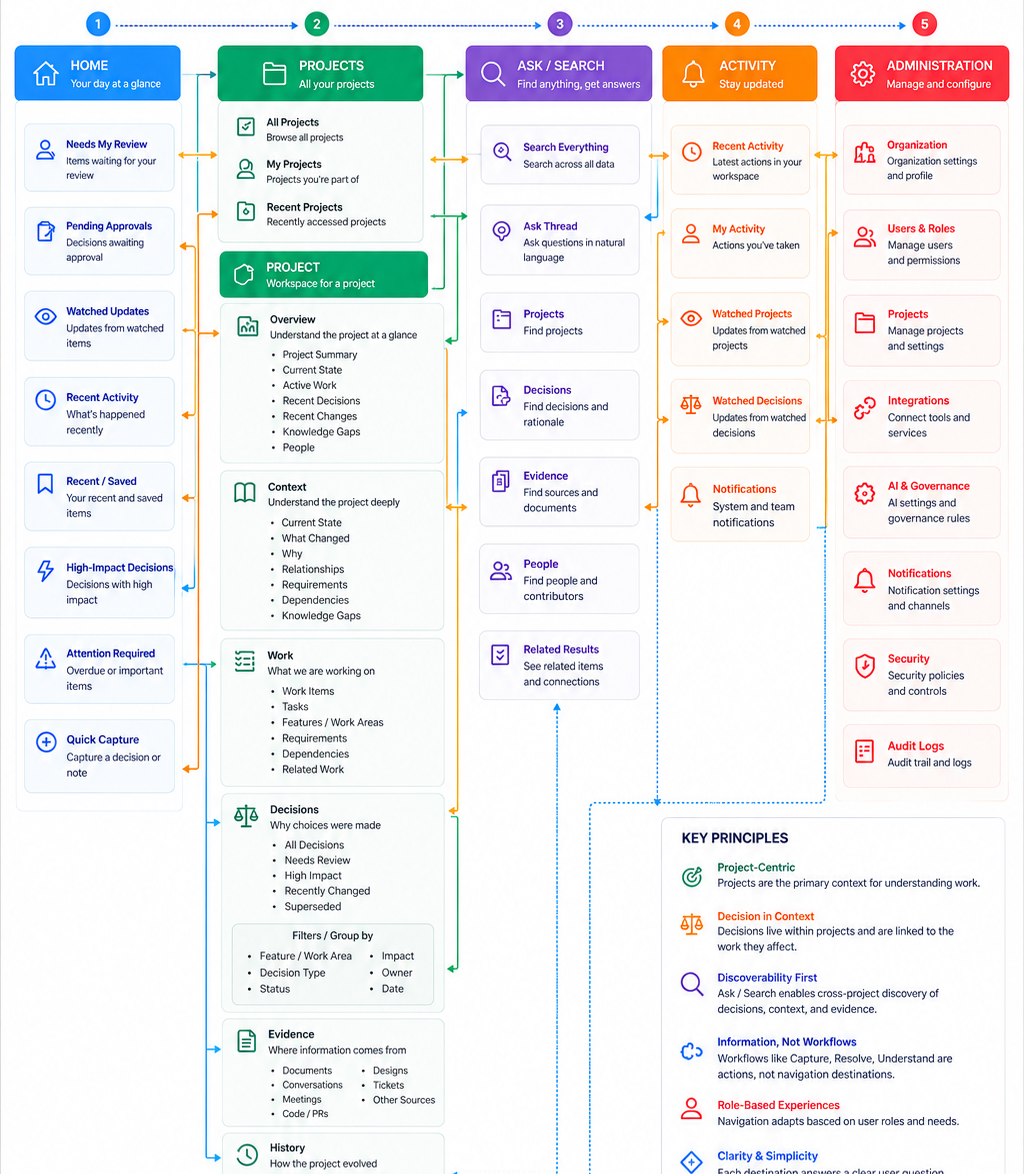
Knowledge Architecture
Project-Centric
Projects are the primary context for understanding work.
Decisions in Context
Decisions live within projects and are linked to the work they affect.
Discoverability First
Ask / Search enables cross-project discovery of decisions, context, and evidence.
Information, Not Workflows
Capture, Resolve, and Understand are actions rather than navigation destinations.
Role-Based Experiences
Navigation adapts based on user roles and needs.
Clarity & Simplicity
Each destination answers a clear user question.
Interaction Model
01
Orient
Receive a synthesized overview of what matters and the current state.
02
Understand
Review the context explaining why the work is structured as it is.
03
Inspect
Trace a specific decision or inspect supporting evidence when deeper investigation is needed.
04
Context Gap
Make insufficient evidence visible rather than filling the gap with a plausible answer.
05
Validate
Route the unresolved question to a human validator.
06
Exit
Leave once sufficient understanding has been reached.
Trust & Knowledge States
Documented
Supported directly by source material and verified records.
Inferred
Reconstructed or derived from connected evidence.
Human Validated
Confirmed or signed off by an appropriate stakeholder.
Unresolved
Available evidence does not establish sufficient understanding.
Conflicting
Relevant sources disagree on decisions or parameters.
Prototype
The high-fidelity prototype demonstrates how Trace helps users reconstruct the context behind unfamiliar work. It uses a synthetic payment-platform scenario involving retry limits, idempotency, and vendor changes. These details are synthetic demonstration data and are not empirical research findings.
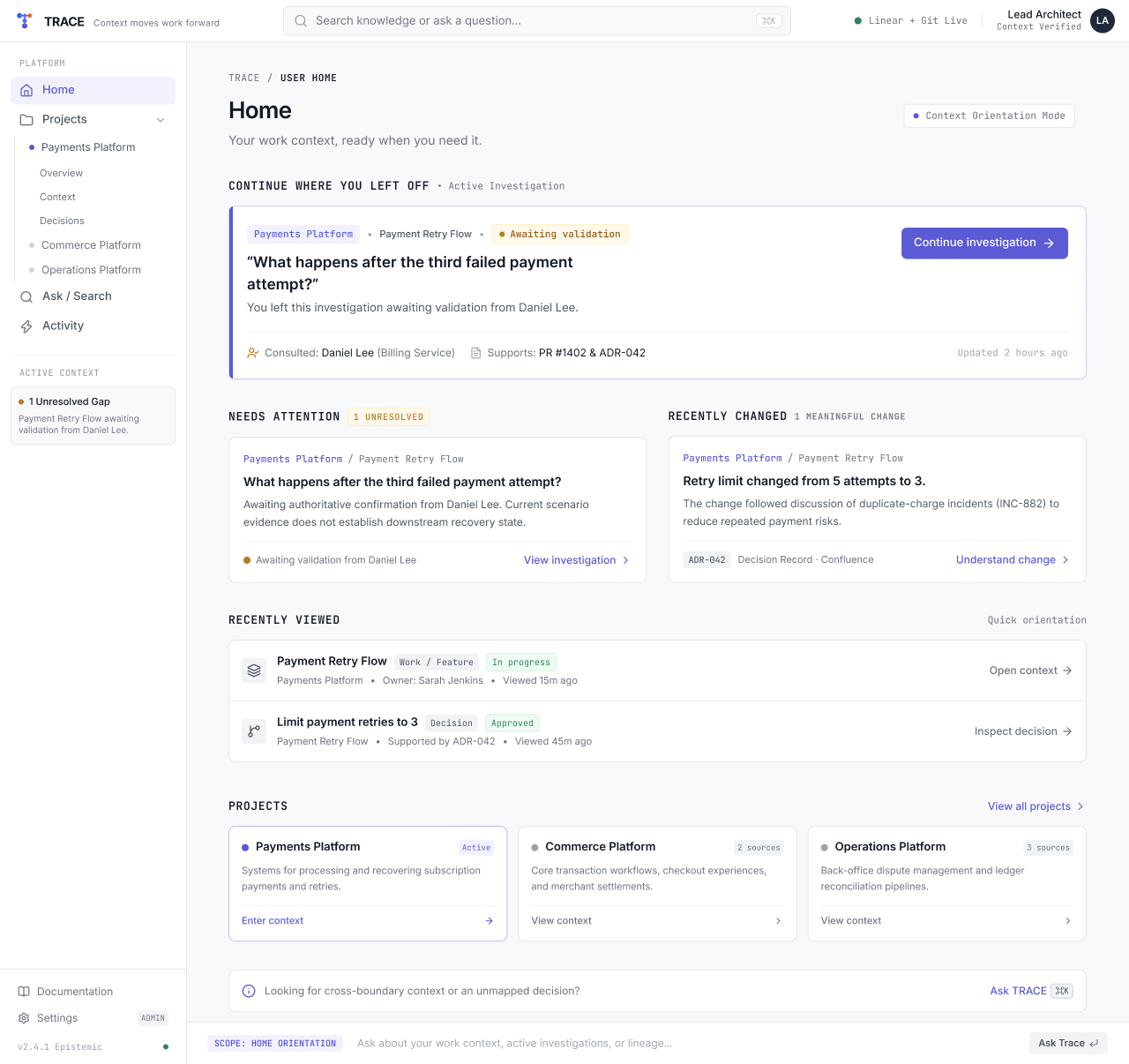
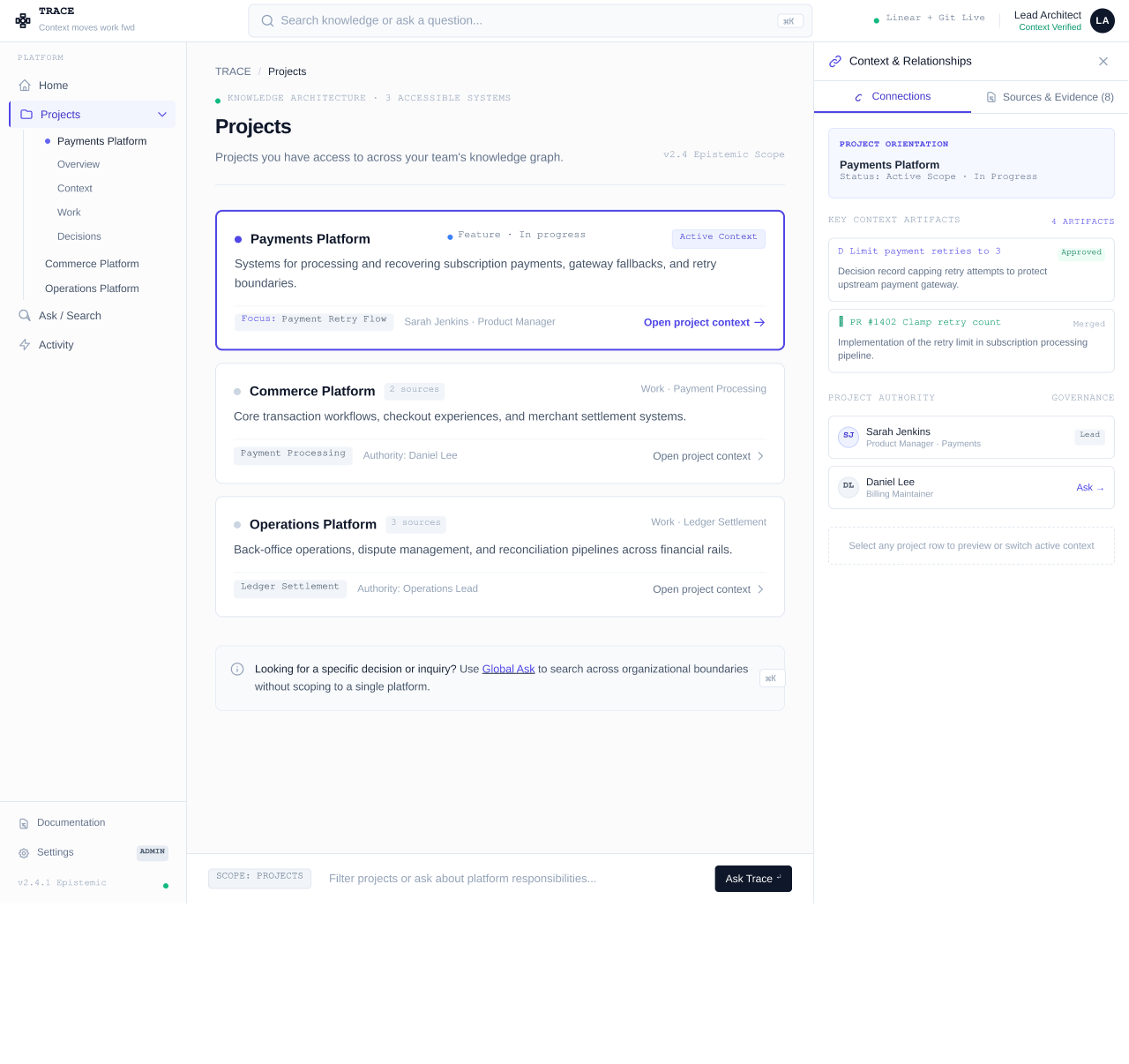
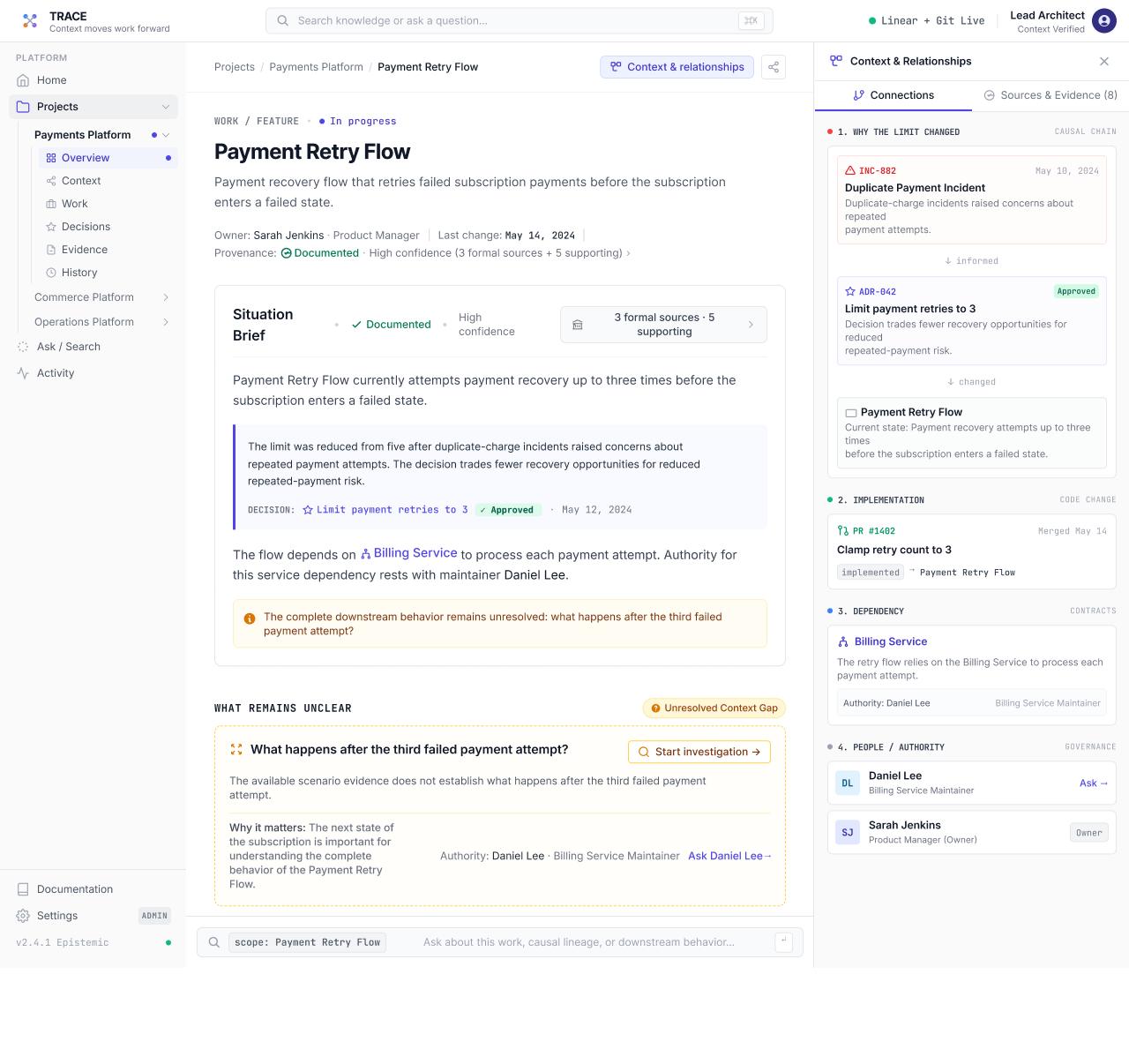
Orienting Around Work
The user quickly understands what the work is, why its current state matters, and where important context or uncertainty remains.
Reconstructing Context
The user connects current state, decisions, dependencies, and evidence to build a coherent understanding.
Inspecting a Decision
The user can isolate a specific architectural decision and trace its constraints, rejected alternatives, and stakeholder approvals.
Encountering a Context Gap
When evidence is insufficient, Trace does not guess. It exposes a Context Gap and routes the question to an identified human validator.
Final Solution
01
Orient
Start with a synthesized overview of the work, its current state, key relationships, and areas of uncertainty.
02
Understand
Move into linked decisions and trade-offs to understand why the work is structured as it is.
03
Investigate
Inspect supporting evidence when needed. If evidence runs out, Trace exposes a Context Gap and routes it to a human validator instead of guessing.
04
Exit
Leave the flow once enough context has been gathered to continue working with confidence.
Core Capabilities
Synthesized Orientation
Lead with understanding rather than endless document search results.
Decision Basis Taxonomy
Classify reasoning as Evidence-Backed, Authority-Directed, or Constraint-Driven.
Epistemic Knowledge States
Distinguish Documented, Inferred, Human Validated, Unresolved, and Conflicting knowledge.
Graceful Failure Escalation
Route unresolved context to human owners instead of generating plausible guesses.
Experience Shift
Before Trace
Unfamiliar work → search artifacts → switch between tools → read documents → ask people → reconstruct decisions → build a mental model → continue working.
With Trace
Unfamiliar work → synthesized orientation → understand context → trace relationships → inspect evidence when needed → validate unresolved information → take action.